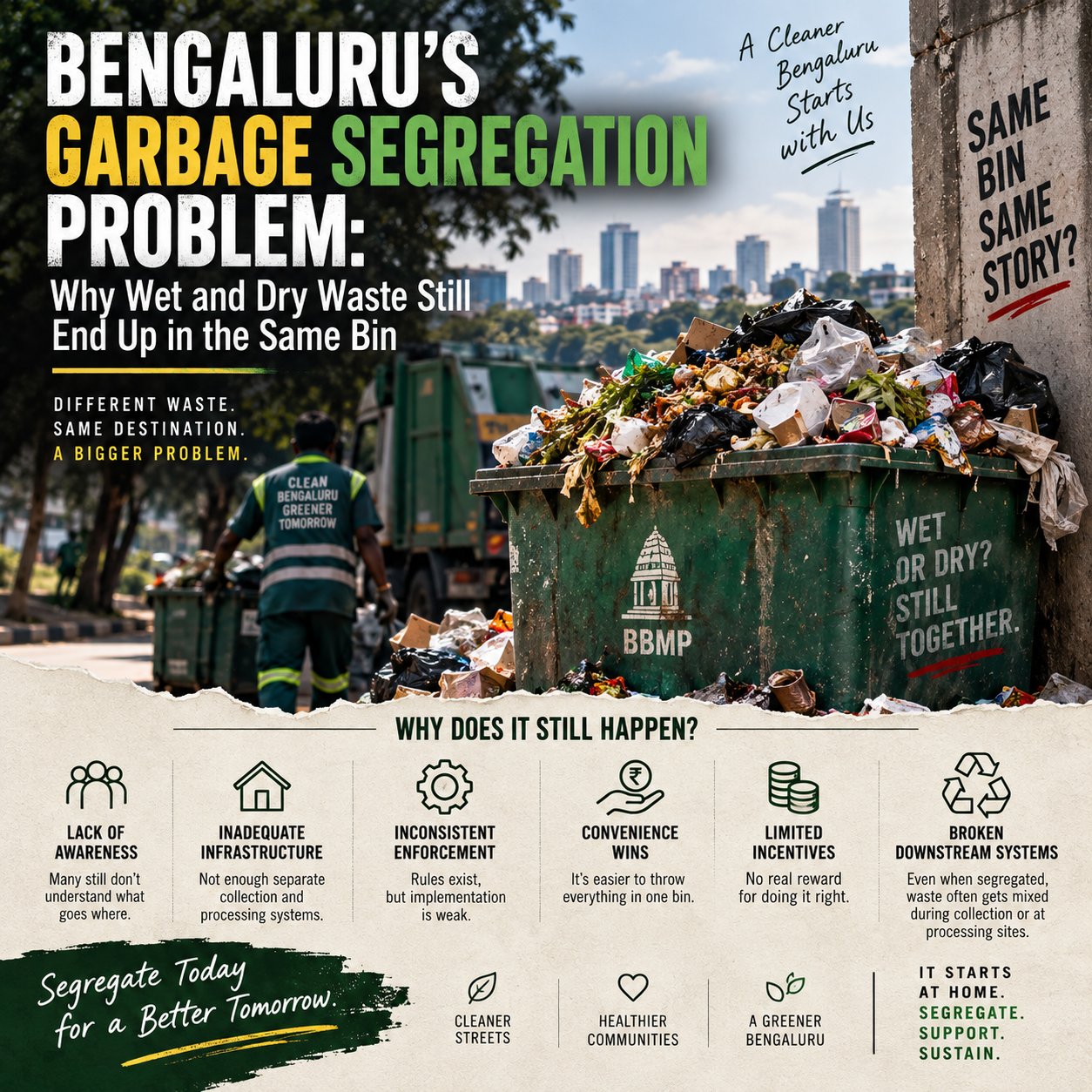
Every household in Bengaluru has heard the rule by now: wet waste in one bin, dry waste in another. BBMP has enforced it, fined for it, and run awareness drives about it for over a decade. And yet, on collection day, it's still common to see a single mixed bag going into the truck. Why does a rule this simple keep failing at this scale?
The rule, and why it exists
Segregation at source — sorting biodegradable ("wet") waste like food scraps from non-biodegradable ("dry") waste like plastic, paper, and metal — isn't a Bengaluru-specific idea. It's mandated nationally under the Solid Waste Management Rules, 2016, which the Bruhat Bengaluru Mahanagara Palike (BBMP) is responsible for enforcing locally. The logic is straightforward: wet waste can be composted or processed close to where it's generated, dry waste can be sorted and recycled, and almost nothing needs to reach a landfill if the split happens correctly at the doorstep.
A city generating waste faster than it can sort it
Bengaluru generates several thousand tonnes of municipal solid waste every single day, and that volume has only grown with the city's population and consumption patterns. Waste management at that scale depends almost entirely on compliance happening at millions of individual doorsteps before a truck ever arrives — there's no centralized fix that works if the sorting doesn't happen at the source.
Where the system breaks down
Segregation compliance in Bengaluru has been patchy for years, and it isn't really one failure — it's several, stacked on top of each other. Many households still don't segregate consistently, treating it as optional despite the rule. Waste collection vehicles have, at times, been reported mixing already-segregated waste back together during pickup, undoing a resident's effort before it even reaches a processing facility. And apartment complexes and bulk waste generators — required to manage their own wet waste on-site in many cases — don't always have the composting infrastructure the rules assume they do.
The landfills that made the problem impossible to ignore
Bengaluru's waste segregation push didn't emerge in a vacuum. Landfills at Mavallipura and later Mandur became notorious through the 2000s and 2010s, drawing sustained protests from surrounding villages over contaminated groundwater, foul air, and health complaints, and were eventually shut down under public and legal pressure. Those closures are a big part of why source segregation became policy rather than a suggestion — Bengaluru effectively ran out of places willing to accept its mixed waste.
A landfill doesn't reject waste because it's plastic or food scraps. It becomes a crisis because it's both, mixed together, with nowhere left to sort it out.
The informal system holding the gaps together
A meaningful share of whatever recycling does happen in Bengaluru is only possible because of the city's informal waste picker economy — workers who manually re-sort mixed waste that should have already been separated. It's a reminder that when source segregation fails, the burden doesn't disappear — it just shifts onto some of the city's least protected workers. (We wrote about the people behind that work in The Hands That Keep Bengaluru Clean.)
What's actually working, in pockets
The picture isn't uniformly bleak. BBMP's network of Dry Waste Collection Centres gives dry waste a legitimate, organized channel once it's properly separated, and specific wards with active resident welfare associations have shown that near-complete segregation is achievable when there's consistent local follow-through — door-to-door checks, resident education, and accountability for collection crews. The rule works where someone locally owns making it work.
Why this matters to us
Segregation is one of the clearest examples we've seen of a problem that isn't about technology or funding — it's about everyday behavior at scale, sustained over years. It's exactly the kind of gap Ecoverse is built to close: gamifying everyday green actions like recycling so that doing the right thing at the bin has some immediate, visible payoff instead of relying on civic duty alone to carry a city-wide system.
Want to work on problems like this with us?
Whether it's a sustainability initiative, a technology partnership, or a conversation about what's next — we'd love to hear from you.
Partner With Us